

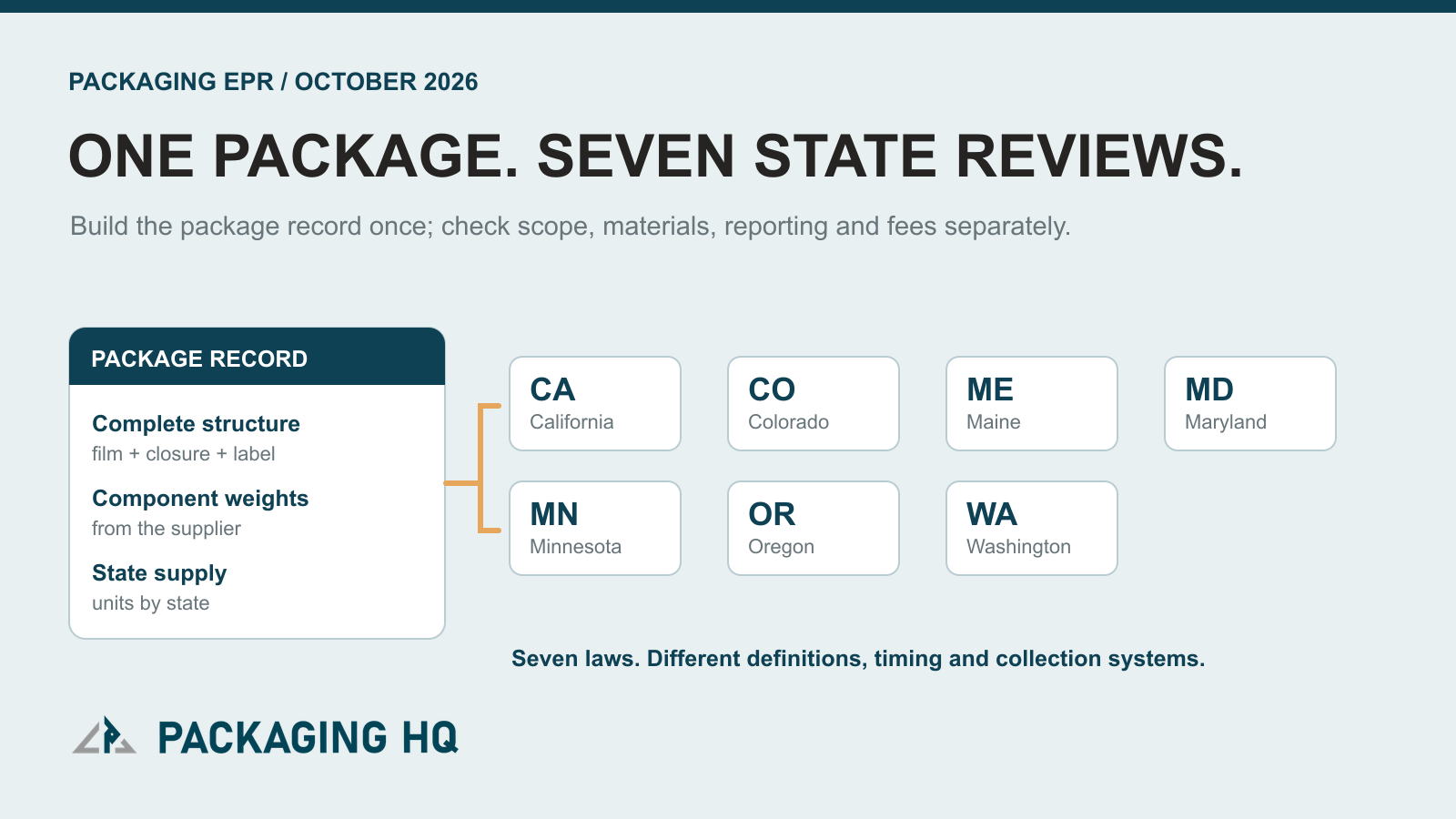
If your snack pouch sells in several states, one “recyclable film” statement will not answer every packaging reporting question. As of October 26, 2026, California, Colorado, Maine, Maryland, Minnesota, Oregon, and Washington have enacted packaging extended producer responsibility, or EPR, laws. These programs are not seven copies of one rule, and they are not at the same stage. 1 2 3 4 5 6 7
EPR makes a defined “producer” help fund or manage packaging after use, usually through a producer responsibility organization, or PRO. For a brand, the immediate job is to identify the exact package sold in each state, who is legally the producer, and what material data the program requests. Packaging HQ can help compare the packaging you actually buy with supplier specifications, organize material and weight inputs, and evaluate changes that could avoid unnecessary cost. Contact Packaging HQ for a packaging review; legal interpretation should come from qualified counsel.
01
Start with the package, not a state deadline
Make one record for each package configuration. A coffee bag with a zipper, valve, printed laminate, and label is not just its main film. Record the brand and SKU, the company placing it into each state, packaging components, material family, weight by component, supplier, and annual units by state. Keep the supplier specification and any recycling assessment beside that record. If one SKU changes construction during the year, preserve both versions and their effective dates.
This is practical cost control. A component omitted from the inventory can distort reported weight. A material described too broadly can be assigned to the wrong category. A proposed lighter film may save resin but add seal failures or product loss. Ask a converter for the complete structure, finished-pack weight, and any test evidence before pricing a redesign. California publishes covered material categories and recyclability determinations that make this mapping concrete. 1 8
02
Seven states, different operating positions
Oregon is already operating. Since 2025, covered producers have had to register with an approved PRO, report covered products supplied in or into Oregon, and pay fees; the state identifies a small-producer exemption. Oregon also has material acceptance lists, so a flexible pouch’s fee treatment and its route into a recycling program are separate questions. 6 9
Colorado has an approved PRO plan. Circular Action Alliance, or CAA, says its final plan was approved December 9, 2025, and implementation began in 2026. Colorado distinguishes a minimum recyclable list from an additional materials list. Do not assume that a pouch on a supplier’s “recycle-ready” list is collected statewide. 2
California adopted permanent SB 54 regulations effective May 1, 2026. CalRecycle received CAA’s proposed producer responsibility plan October 13 and is taking comments through November 13. The state has its own covered material categories, source-reduction framework, and recyclability determinations. This program deserves its own material mapping rather than a copy of another state’s report. 1 8
Maine enacted a packaging stewardship law in 2021, but it is at a different implementation stage. CAA says it did not bid on Maine’s 2026 stewardship organization request and does not currently administer a Maine program. Brands should monitor the state’s eventual stewardship organization and registration process rather than assume their CAA account covers Maine. 3
Maryland signed its packaging and paper products law in May 2025. The Maryland Department of the Environment identifies CAA as the approved PRO and posted final regulations in May 2026. A brand should check its producer definition, covered packaging, and current reporting instructions there; another state’s exemption does not automatically carry over. 4
Minnesota enacted its Packaging Waste and Cost Reduction Act in 2024. Its agency says producers are generally brand owners, manufacturers, or importers and must join a nonprofit PRO. Minnesota is still taking comments on a draft needs assessment through November 13, 2026. The law also sets a 2032 condition tied to packaging being supported by a refill, reuse, recycling, or composting system. That future design condition is more specific than a supplier saying a film is technically recyclable. 5
Washington passed its Recycling Reform Act in 2025. Starting in 2026, the state says covered producers of residential consumer packaging and paper products must register with a PRO, report, and pay fees. Its preliminary needs assessment is open for comment through October 30, 2026; broad service reimbursement and expanded collection begin later. Washington’s residential scope means a buyer must check whether each package is covered, not just whether the brand sells into the state. 7 10
03
Why flexible packaging needs a closer look
“Mono-material” describes a package design. “Designed for recycling” describes how that design fits a technical guideline. Neither says a local program accepts the finished pouch or that it is collected and recycled at scale. A PE-based snack pouch may still include a zipper, ink, adhesive, barrier, or label that changes its assessment. Oregon’s published acceptance lists and California’s category determinations show why the actual package and state system matter. 8 9
Ask the supplier: What is the finished package’s construction and weight, including closures and labels? Which exact state material category does the evidence support? What collection route exists for that complete package? If a recycling claim appears on-pack, what assessment supports it in the intended market? Keep answers separate from a fee estimate. Program fees can reflect material categories, amounts supplied, and state-specific rules; CAA cautions that schedules and deadlines vary by state. Some programs also vary fees to encourage preferred design attributes, often called eco-modulation. Minnesota describes that approach in its current program guidance. 5 11
04
A useful next step for a multi-state brand
Assign one owner to the package record and one owner to the legal applicability review. Work through your highest-volume package first. The packaging owner gathers structures, component weights, supplier evidence, and state sales volumes. The legal or compliance owner checks producer status, exemptions, registration, and reporting against each current state source. Then compare any proposed redesign with the current pack on protection, line performance, delivered cost, and end-of-life evidence.
Use the seven-state package review tracker to make those gaps visible. It is a working record, not an eligibility ruling or fee calculator. If a pouch, sachet, or film change is under consideration, talk with Packaging HQ. We can help organize supplier inputs, compare the proposed structure with what you use now, and plan the packaging work around a compliance review.
FREQUENTLY ASKED QUESTIONS
FAQs
Does one PRO registration cover all seven states?+
No. CAA operates in six of the seven states listed here, but says it does not currently administer Maine’s program. Even where the same PRO is involved, the state law, covered material definitions, and reporting instructions differ. 3 11
Is the brand owner always the producer?+
No. Producer definitions differ and can depend on branding, manufacture, licensing, importing, and distribution. Washington lists several possible responsible parties; Minnesota says generally brand owner, manufacturer, or importer. Check the exact state rule and commercial arrangement. 5 7
Does a recyclable film make the finished pouch recyclable?+
No. Evaluate the complete pouch, including zipper, spout, label, inks, adhesives, and barriers, against the relevant design guideline and collection program. Technical potential, program acceptance, and recycling at scale are distinct. 8 9
Should a small brand ignore EPR?+
No. Some programs have exemptions or simplified treatment, but thresholds vary. Oregon identifies a small-producer exemption and Washington lists a de minimis category. Confirm each state’s current rule using your own volume, revenue, and corporate structure. 6 7
Can one packaging redesign solve every state issue?+
Possibly, but it needs proof. The same construction must still protect the product, run on the line, fit each state’s material definitions, and have a supported end-of-life claim. Compare the finished pack and real collection route before changing labels or marketing language. 1 2 5
Primary sources
1. CalRecycle, SB 54 program and current news↗2. Circular Action Alliance, Colorado program and approved plan↗3. Circular Action Alliance, Maine program status↗4. Maryland Department of the Environment, producer responsibility↗5. Minnesota Pollution Control Agency, packaging EPR↗6. Oregon Department of Environmental Quality, producers of covered products↗7. Washington Department of Ecology, producers and the PRO↗8. CalRecycle, SB 54 covered material categories↗9. Oregon DEQ, recycling material acceptance lists↗10. Washington Ecology, Recycling Reform Act status↗11. Circular Action Alliance, producer resources and state timelines↗