Nutraceuticals & Supplements

Flexible packaging built around your product and production process

From multi-lane stick packs to pouches, sachets, and blister materials, Packaging HQ helps brands and co-manufacturers develop packaging that supports product quality and performs consistently in production.

Moisture barrier, seal integrity, print durability, slitting accuracy, and forming behavior all matter. We bring those requirements together so the package works for the product, the equipment, and the people running it.

Schedule a Call ↗
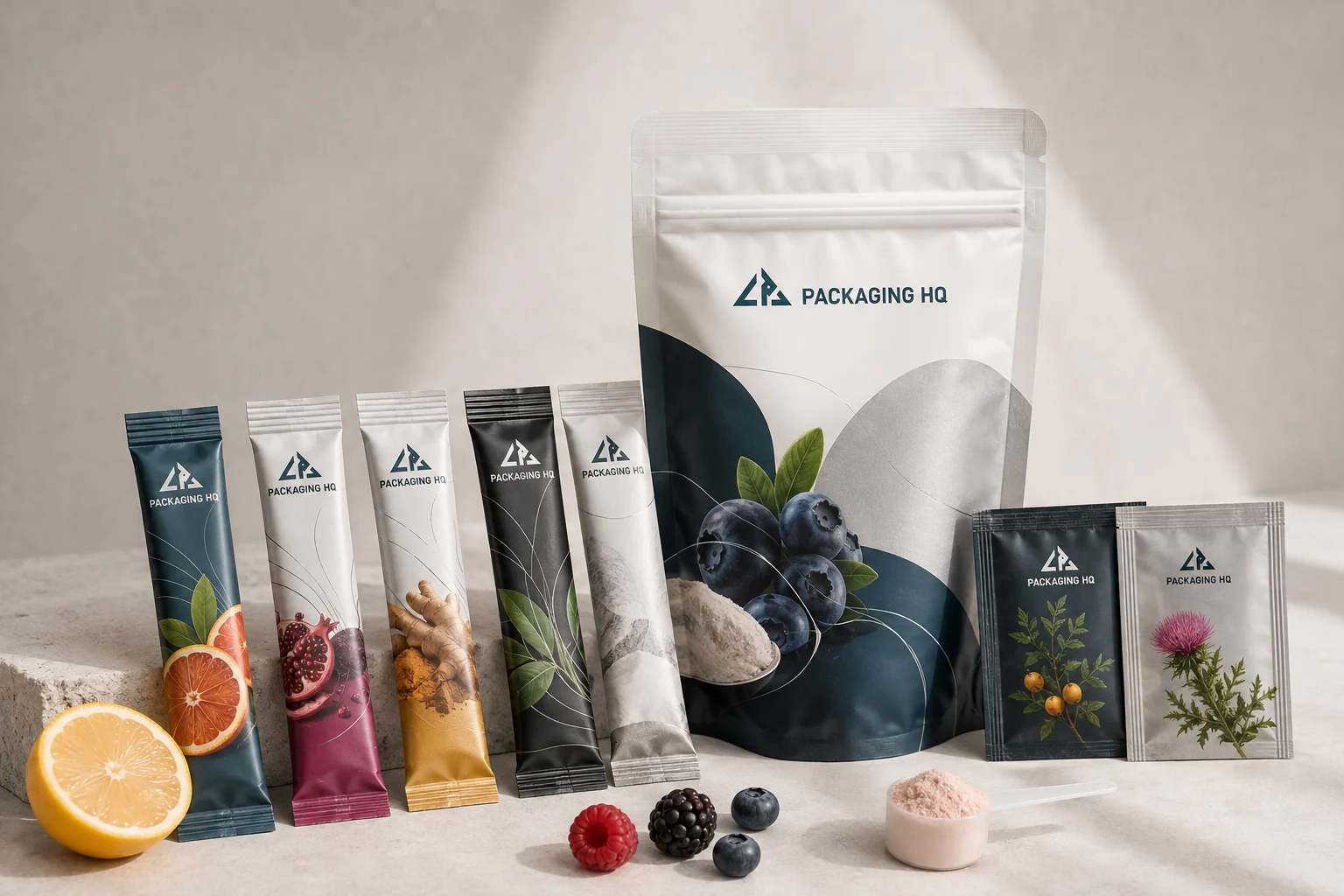
Packaging HQ branded stick packs, supplement pouch, and sachets with fruit and botanical graphics
Nutraceuticals & Supplements

Stick packs lead this family, supported by resealable powder pouches and sachets. The product, filling process, barrier target, seal conditions, and co-manufacturer requirements guide the final specification.

Packaging formats

Start with the format that fits the product.

The product form, dose, filling process, consumer use, and production plan help determine which format belongs at the center of the program.

02

Pouches

Pouches can serve as the primary package for loose powders, tablets, capsules, gummies, and other supplement products. They can also serve as an outer package that groups finished stick packs while providing branding, organization, and additional protection when needed.

For loose powders, zipper selection matters. Powder-resistant and wider-channel zipper profiles can make reclosing easier when particles collect around the zipper. The best option should be tested with the actual product because powder size and flow behavior affect performance.

Explore pouches
03

Sachet and packet films

Sachets provide a compact format for powders, liquids, gels, tablets, gummies, and sample doses. Film design must account for the product, fill process, seal area, opening method, and level of barrier required.

Liquids and gels may place different demands on the sealant than dry powders or solid doses.

Explore sachet and packet films
04

Blister materials

Packaging HQ can supply printed or unprinted push-through lidding material, cold-form blister foil, and thermoformable forming webs.

The material system is selected around the product, required protection, package design, and blister equipment.

Explore blister materials Explore forming webs

A three-way partnership

Better packaging starts with the right people at the table.

A specification cannot be developed around the product alone. The filling method, equipment, lane configuration, sealing conditions, package dimensions, production speed, and quality requirements all affect how the film should be designed.

01

The brand

The brand brings the product requirements, quality expectations, customer experience, graphics, volume forecasts, and commercial goals.

02

The co-manufacturer

The co-manufacturer brings the production details. This includes the equipment, web and repeat requirements, lane configuration, sealing conditions, roll specifications, and experience running the product.

03

Packaging HQ

Packaging HQ brings these requirements together and helps develop a package that supports the product while running consistently in production. We can work directly with the brand and co-manufacturer to confirm specifications before production.

If an existing specification or package sample is available, it can give us a useful starting point. If the package is still being developed, we will help identify the information needed to move forward.

Production priorities

What consistent performance looks like.

01

Moisture barrier that fits the product

Many powders and supplement ingredients are sensitive to moisture. The package structure should be selected around the actual product, expected storage conditions, distribution environment, and intended quality period. Barrier data provides a useful starting point, but the completed package still needs appropriate validation.

02

Reliable multi-lane performance

Stick-pack film must be slit consistently and perform across every lane. Variations in slitting, registration, tension, forming, or sealing can create problems that repeat throughout a production run.

03

Stable print and varnish

Many stick packs use surface printing. The ink and protective varnish must remain stable as the film travels through the machine and comes into contact with rollers, forming components, and other surfaces.

04

Seals that account for product contamination

Powder can enter the seal area during filling. The film should be designed to seal through the expected level of contamination and reduce the risk of package failure. Final performance must be confirmed using the actual product and production conditions.

05

Price considered alongside performance

Price is an important part of the decision, especially for high-volume programs. It should be evaluated alongside film consistency, barrier, print quality, production performance, waste, and the reliability of the finished package.

Shelf and brand experience

Create a package that feels credible before it is opened.

Supplement packaging can use format, proportion, color, metallic details, soft-touch or tactile finishes, and clear product organization to build trust and stand apart. Those choices still need to work with barrier, sealing, filling, dosing, and any outer packaging.

Packaging HQ can work with your existing design team or help you find a design partner. We connect the creative direction with the package format, accurate dimensions, film structure, printing method, finishes, closures, and production requirements.

Bringing packaging into the process before artwork is finalized gives designers accurate panels and dielines while accounting for seals, folds, gussets, zippers, valves, windows, and other features.

Explore printing and graphics

Launch through scale

Start with the right path and plan for growth.

A growing brand may need a different production path than an established high-volume program. Packaging HQ helps select an approach based on the package requirements, order volume, graphics, timing, and expected growth.

As demand increases, we can help plan the transition to larger production volumes while keeping the important parts of the specification controlled. Barrier, dimensions, sealing performance, print appearance, roll configuration, and production requirements should remain clearly documented through each stage.

Production trials

For new or redesigned packaging, a production trial is the preferred way to confirm performance before committing to a full production order. Packaging HQ can coordinate the trial with the brand and co-manufacturer while keeping the process focused on the requirements of that specific program.

Experience Behind Packaging HQ

Nutrition bars / Horizontal flow wrap

When leakers had become part of the process.

A nutrition-bar manufacturer was running several flow-wrap lines around the clock. Employees stood at the end of each line checking every bar for leakers. More people had been added as production increased, but inspection could only find the failures. It could not solve what was causing them.

The film met the supplier specification, but it was not forming a consistent hermetic seal under the normal variation of the equipment. The experience behind Packaging HQ led to a redesigned film specification that provided better seal performance and improved barrier without disclosing the proprietary structure.

After a full production trial, the customer used its established testing process to evaluate the change. Rework fell below the company's accepted level, and the employees assigned to inspection were moved to other productive work.

Within one month, the customer estimated that the reassigned labor represented more than $700,000 in annual capacity. The reduction in rework created additional value.

$700K+Customer-estimated annual labor capacity recovered within one month of the change

This project was personally led by Packaging HQ’s founder before Packaging HQ was established. Customer-reported results reflect specific operating conditions, vary, and are not guaranteed.

Read the nutrition-bar packaging case study

Nutraceutical packaging questions

Questions about stick packs, pouches, and blister materials.

Does every stick pack need a foil barrier?01

No. Foil is common because it provides broad barrier performance along with the stiffness and dead fold that support stick formation. The final structure should still be selected around the product, filling process, equipment, and required package performance.

What information is needed to quote stick-pack film?02

Useful information includes the finished dimensions, film width, repeat, lane configuration, roll requirements, product type, filling method, barrier targets, print files, expected volume, and co-manufacturer details. An existing specification or package sample can also be uploaded when available.

Can Packaging HQ work directly with our co-manufacturer?03

Yes. With the brand's approval, Packaging HQ can work with the co-manufacturer to confirm production and film requirements before an order is placed.

Does an outer pouch need the same barrier as the individual stick packs?04

Not always. When the individual stick pack provides the product-contact seal and required barrier, the outer pouch may primarily provide grouping, branding, and physical protection. Additional barrier can be added when the product, distribution conditions, or intended use requires it.

Should a new film be tested before a full production order?05

A production trial is recommended for a new or redesigned film. It provides an opportunity to evaluate the film with the actual product, equipment, and production conditions before moving to full volume.

Can Packaging HQ supply blister packaging materials?06

Yes. Packaging HQ can supply printed or unprinted push-through lidding material, cold-form blister foil, and thermoformable forming webs.

Continue the project

Related supplement packaging topics.

Let’s solve it together

Have a package to quote or a problem to solve?

Send the known specification or tell us about the product, format, filling process, co-manufacturer, and expected volume. A Packaging HQ expert will help identify what is still needed.