Coffee

Coffee packaging built around the roast, the package, and the way it reaches the customer

Whole-bean and ground coffee need the right oxygen, moisture, aroma, and light protection, along with dependable seals, closures, and degassing. The package should be built around the coffee and how it moves from roasting to the customer.

Cold brew and concentrates add liquid containment, product compatibility, processing, and distribution requirements. Packaging HQ brings these needs together with the package format, filling process, sales channel, and brand presentation.

Schedule a Call ↗
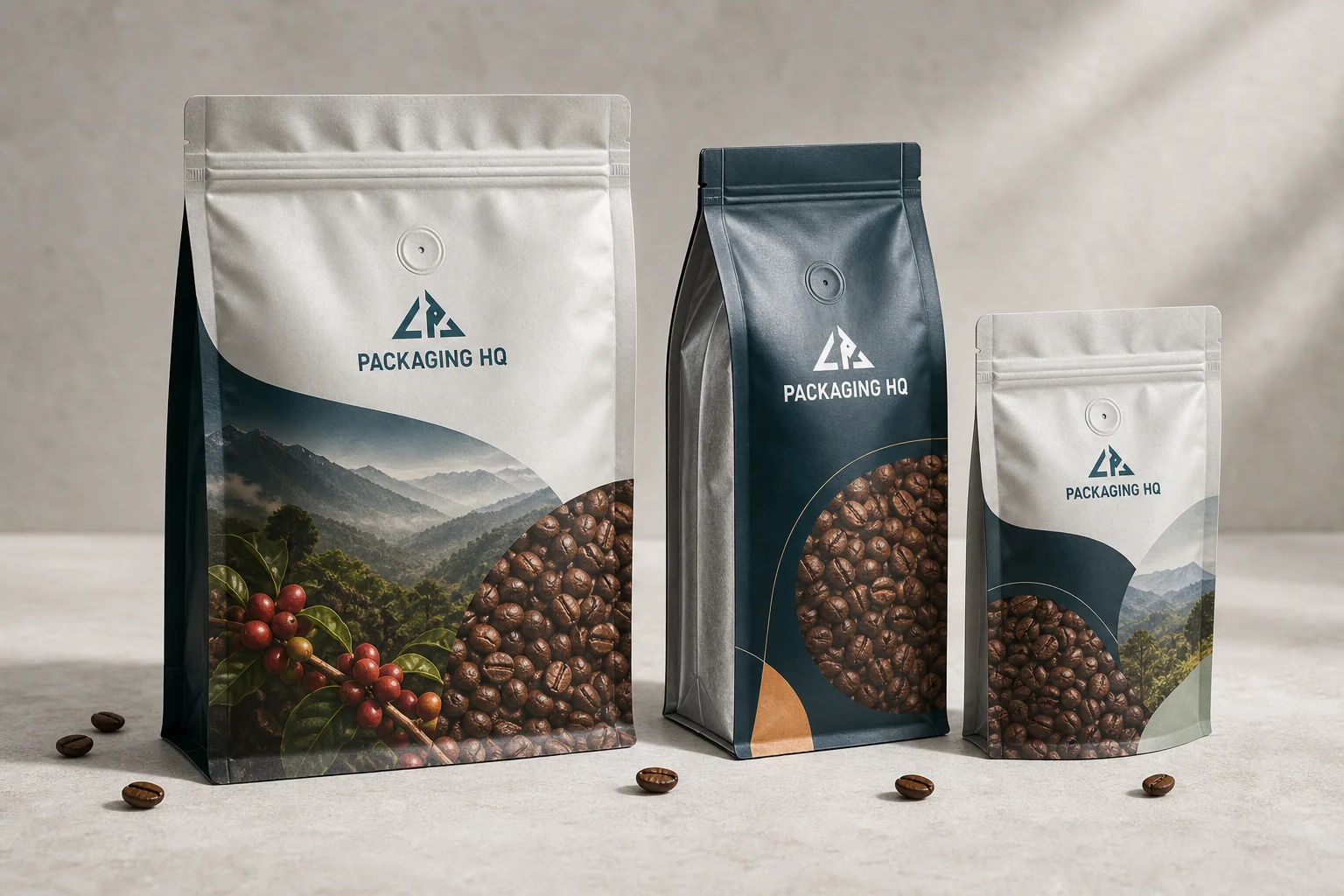
Packaging HQ branded flat-bottom, side-gusset, and stand-up coffee pouches with degassing valves
Coffee

Flat-bottom, side-gusset, and stand-up packages can use different closure and valve paths. The coffee, roast-to-pack timing, barrier, filling, and distribution guide the final package.

Coffee package formats

Start with the way the coffee will be filled, sold, and used.

The best format connects fill weight and density with closure, valve, shelf presentation, production, and distribution.

02

Side-gusset and quad-seal bags

Side-gusset bags provide a familiar coffee format with expandable panels and an efficient front-facing footprint. They are commonly paired with a degassing valve, tin tie, zipper, or sealed top.

Quad-seal bags add seals along the four vertical corners to create more defined panels and added structure for larger or heavier fills. Gusset depth, bag width, fill method, seal strength, and finished shape guide the choice.

Explore this packaging path Explore quad-seal bags
03

Stand-up pouches

Stand-up pouches work well for whole-bean and ground coffee across smaller retail packs, specialty blends, samples, and subscription programs. They provide strong front and back graphic areas with an adaptable bottom gusset.

Pouch width, height, gusset depth, fill density, headspace, closure, valve, film stiffness, filling, and delivery method affect how the finished package stands and looks.

Explore this packaging path
04

Roll stock and machine-made bags

Roll stock is used to form pillow bags, fin-seal packages, gusseted bags, fractional packs, and other coffee formats on automated equipment.

Web width, repeat, unwind, roll configuration, registration, friction, stiffness, sealing, line speed, product drop, and any in-line valve application must fit the actual packaging line.

Explore this packaging path

Product requirements

Different coffee products ask different things of the package.

01 / WHOLE-BEAN COFFEE

Plan for continued degassing.

Whole-bean coffee may continue releasing carbon dioxide after roasting. Roast level, time before packing, headspace, bag size, and expected distribution help determine whether a degassing valve belongs in the package.

Barrier, closure, consumer use, and the way the beans settle should be considered with the valve decision rather than after it.

02 / GROUND COFFEE

Protect a product with more exposed surface area.

Grinding exposes more of the coffee to the surrounding environment. Ground coffee can release gas and lose aroma more quickly, so oxygen and aroma protection, grind size, pack timing, and the seal area deserve direct attention.

Grounds can collect in zippers or the final seal. The closure, sealant, filling process, and contamination tolerance should be developed around the actual product.

03 / COLD BREW AND CONCENTRATES

Build around the liquid and the process.

Cold brew and coffee concentrates introduce product compatibility, liquid containment, fitments, processing, and refrigerated or ambient distribution requirements. Options can include spouted pouches, liquid sachets, portion packs, lidding films, labels, and specialty flexible formats.

Packaging alone does not make a liquid coffee product shelf-stable. The formulation, treatment method, filling process, package, and storage conditions must be evaluated as a complete system.

04 / PODS AND FILTER PACKS

Coordinate the complete single-serve system.

For coffee pods, the pod body, filter, lidding material, seals, and any secondary packaging work together. The lid must seal consistently, contain the grounds, survive distribution, and perform in the intended brewing system.

Filter packs need controlled water flow during brewing, so an outer wrapper or pouch may provide the oxygen, moisture, and aroma protection needed before use.

Degassing and barrier

A valve and a high-barrier web solve different problems.

01 / WHEN A VALVE HELPS

Give carbon dioxide a controlled path out.

Freshly roasted coffee continues to release carbon dioxide. When it is packed soon after roasting, that gas can build pressure inside a sealed package. A one-way valve is designed to release gas while limiting outside air from moving back through the valve.

A valve should solve a known need, not be added by default. Whole bean or ground coffee, roast level, time before packing, fill weight, headspace, storage, and distribution should guide the decision.

02 / WHY THE WEB STILL MATTERS

Protect the rest of the package surface.

The valve manages gas leaving the package. The web helps limit oxygen and moisture from entering while reducing aroma loss through the package. A valve does not turn a lower-barrier film into a high-barrier package.

For coffee that needs greater protection or may spend more time in storage and distribution, foil or another ultra-high-barrier web may be the right answer. It can provide strong oxygen, moisture, aroma, and light protection that supports the intended product quality over time.

The web, valve, seals, closures, filling process, and storage conditions should be evaluated together. Packaging is one part of product quality and does not guarantee shelf life by itself.

Read the Barrier and Shelf Life Guide

Closures and first opening

Choose the way the customer will close the coffee after opening.

The original top seal provides the initial package integrity. A reclosure helps after opening, but it does not recreate the original sealed condition.

01

Zipper closures

Zippers are common on flat-bottom and stand-up pouches. They provide a familiar repeated reclosure, but their position affects fill space, headspace, tear location, and the final top seal. Grounds can collect in the zipper channel.

02

Tin-tie closures

Tin ties are common on fold-over side-gusset bags and can support a traditional café or roastery appearance. They are simple to use but do not create an airtight or hermetic reclosure.

03

Heat-seal-only packages

Fractional, sample, food-service, and single-use coffee packages may not need a reclosure. A dependable heat-sealed package can be the simpler choice when the contents will be used at once or transferred after opening.

Sizing and filling

Use the actual coffee, not the labeled weight alone.

Whole beans, ground coffee, roast levels, blends, and grind sizes can occupy different amounts of space at the same weight. For example, a 12-ounce dark-roast whole-bean coffee may require more package volume than 12 ounces of a denser light roast or ground product.

A package that is too small may be difficult to fill and seal. A package that is too large may look underfilled, lose its intended shape, or use more material than necessary.

  • Actual coffee density and settling
  • Fill weight and required headspace
  • Degassing after packing
  • Valve, zipper, and top-seal position
  • Manual, semi-automatic, or automated filling
  • Finished shape and case pack
Read the Pouch Sizing Guide

Package and line performance

The complete coffee package has to work together.

Barrier, valve, closure, seals, pouch construction, and production conditions all contribute to the result.

01

Barrier that supports the coffee

Oxygen, moisture, aroma, and light protection should reflect the actual coffee, package size, roast-to-pack timing, storage, and distribution. A valve does not replace the barrier provided by the rest of the package.

02

Valves selected for a reason

A one-way valve can provide a controlled path for carbon dioxide to leave when coffee is packed before it has finished degassing. Coffee that has already released enough gas may not benefit from the added component.

03

Seals designed for coffee filling

Grounds, dust, oils, or bean fragments can enter the seal area. The sealant, package headspace, product control, and filling conditions should be developed together and confirmed in production.

04

Closures matched to consumer use

Zippers, tin ties, and sealed tops offer different reclosure experiences. Their location affects fill space, headspace, artwork, and the final top seal. No reclosure recreates the original sealed package.

05

Film that runs consistently

Pouch opening, stiffness, curl, friction, roll quality, tracking, registration, and sealing can affect the attainable speed and consistency of the packaging line.

06

Testing before larger production

Samples and a production trial with the actual coffee, package, valve, closure, and equipment can confirm sizing and performance before a full production order.

Print and shelf presentation

Give the coffee a package people notice.

Shape, panels, color, texture, and finish should support the brand while remaining practical to print, fill, seal, ship, display, and use.

01 / PACKAGE STYLE

Use the shape as part of the brand.

Flat-bottom pouches provide several defined panels. Side-gusset, quad-seal, stand-up, and machine-made bags create different silhouettes and ways to present the coffee.

Dimensions, panels, folds, seals, zippers, valves, and top closures should be settled before final artwork.

02 / FINISH AND FEEL

Build a finish that supports the idea.

Matte, gloss, soft-touch, tactile, metallic, de-metallized, paper-like, and clear-window effects can create distinct shelf experiences.

Windows and de-metallized areas can change light and barrier protection. Soft-touch coatings or outer films should be reviewed for print, scuff resistance, converting, filling, and handling.

03 / PRINT METHOD

Match the print path to the program.

Digital, gravure, and flexographic printing offer different combinations of timing, order size, repeatability, quality, and production economics.

Color targets and proofs matter when several roasts, origins, or seasonal designs need to look consistent together.

Shelf and brand experience

Connect the shelf idea to a package that can be produced.

Coffee brands can stand apart through the pouch style, proportions, panel layout, print, finish, closure, and small details customers handle every day. Those creative choices should be developed with the coffee, barrier, filling, and distribution requirements in view.

Packaging HQ can work with your existing design team or help you find a design partner. We connect the creative direction with the package format, accurate dimensions, film structure, printing method, finishes, closures, and production requirements.

Bringing packaging into the process before artwork is finalized gives designers accurate panels and dielines while accounting for seals, folds, gussets, zippers, valves, windows, and other features.

Explore printing and graphics

Distribution and sales channels

Design the coffee package for the way it reaches the customer.

01 / RETAIL

Hold the intended shape on shelf.

Retail packages need dependable seals, clear identification, a stable shape, and strong presentation. Dimensions should also work with the display space, case pack, and stocking method.

02 / DTC AND SUBSCRIPTIONS

Plan the pouch and shipping container together.

Parcel delivery may expose coffee bags to drops, compression, bending, and changing temperatures. The pouch, valve, seals, and shipping container should be tested as one delivery system.

03 / FOOD SERVICE

Make larger packages practical to handle.

Food-service packages may be opened repeatedly, stored near heat or moisture, and handled by several people. Fill weight, closure, strength, storage space, and pouring all matter.

04 / LIQUID COFFEE

Protect the delivery path from leaks.

Cold brew and concentrates may require refrigerated distribution, secondary containment, leak protection, and packaging that remains dependable as temperatures and handling conditions change.

Sustainability

Improve the package without giving up the protection the coffee needs.

Coffee may require strong barrier while also using valves, zippers, coatings, inks, and other components. Reducing barrier or removing a layer is not an improvement if the change contributes to unacceptable product quality or unnecessary product waste.

Options may include right-sizing, reducing unnecessary material, qualified mono-material structures, recycled-content films where appropriate, paper or paper-look options, compostable structures for suitable applications, refill programs, and improved case packing.

The complete package must be reviewed. A mono-material pouch can still include a valve, zipper, barrier treatment, ink, coating, or adhesive that affects its recovery path. A paper appearance does not automatically make a package recyclable or compostable.

Compare complete packages

Foil can provide excellent protection but may limit recovery options. Packaging HQ can help compare the material, product protection, filling, consumer use, distribution, and realistic recovery path before a claim is made.

Explore the Sustainability hub

Launch through scale

Begin with what is known and build the right coffee package from there.

A growing brand may start with a fill weight, package idea, and initial quantity. An established roaster may have a complete specification. Packaging HQ can support either starting point and help keep the approved requirements controlled as the program grows.

01

The brand and roaster

They bring the coffee, roast and pack timing, quality expectations, customer experience, sales channels, graphics, volume forecast, and commercial goals.

02

Production and creative teams

The co-manufacturer or filling team brings the equipment and operating requirements. The designer brings the visual direction. Both need accurate dimensions, features, and approval points.

03

Packaging HQ

Packaging HQ brings those inputs together and helps define the format, size, barrier, valve, closure, print path, finishes, production details, samples, and trial plan.

As volume, varieties, equipment, or distribution changes, Packaging HQ can help update the package without losing sight of the requirements that made the approved version work.

Troubleshooting

Start with the symptom, then look at the complete system.

Coffee packaging problems can involve the product, package, valve, closure, filling line, storage, or distribution. Avoid changing several variables before the failure is understood.

01

The bag is swelling

Review roast-to-pack timing, degassing, headspace, valve performance, temperature, and elevation changes.

02

Seals are weak or leaking

Check grounds or oils in the seal area, pouch position, folds, seal settings, and whether the sealant fits the process.

03

Aroma or quality changes too soon

Review the barrier, seals, valve, storage, distribution, and product handling before packing. Packaging is one part of the product system.

04

The pouch looks underfilled

Confirm the actual coffee density, fill weight, dimensions, gusset design, and how the coffee settles after filling.

05

The zipper is difficult to close

Grounds may collect in the zipper channel. Review the zipper style, position, package opening, and expected consumer use.

06

Roll stock will not run consistently

Compare curl, stiffness, friction, tracking, registration, forming, product drop, and sealing with the equipment settings.

Open the Packaging Troubleshooting Guide

Coffee packaging questions

Questions about valves, barrier, sizing, and formats.

Does every coffee bag need a degassing valve?01

No. A valve is useful when coffee will continue releasing enough carbon dioxide after sealing that the gas needs a controlled path out. Coffee that has already released enough gas before packing may not need one. Whole bean or ground coffee, roast level, roast-to-pack timing, fill weight, headspace, storage, and distribution should guide the decision.

Why does high barrier matter when a coffee bag has a valve?02

The valve and packaging web perform different jobs. The valve releases carbon dioxide. The web limits oxygen and moisture from entering and reduces aroma loss through the package surface. A valve does not turn a lower-barrier film into a high-barrier package.

When should coffee packaging use foil or another ultra-high-barrier web?03

Foil and other ultra-high-barrier webs may be appropriate when the coffee needs greater oxygen, moisture, aroma, or light protection, or when storage and distribution place more demand on the package. The web, valve, seals, closures, filling process, and storage conditions should be evaluated together. Packaging supports product quality but does not guarantee shelf life by itself.

What bag style works best for coffee?04

The answer depends on the coffee, fill weight, density, closure, valve, filling method, shelf presentation, and distribution. Flat-bottom pouches lead many premium programs. Side-gusset, quad-seal, stand-up, and machine-made roll-stock packages may be a better fit for other products and operations.

How should a coffee pouch be sized?05

Use the actual coffee whenever possible. Whole beans, ground coffee, roast levels, blends, and grind sizes can occupy different volumes at the same weight. Fill weight, density, settling, headspace, degassing, valve and zipper placement, top-seal area, filling method, and case packing all affect the dimensions.

Should a coffee bag use a zipper or a tin tie?06

Zippers are common on flat-bottom and stand-up pouches and provide a familiar repeated reclosure. Tin ties are common on fold-over side-gusset bags and support a traditional roastery appearance. Neither recreates the original sealed condition after opening, so the choice should follow the bag style and expected consumer use.

Are degassing valves supplied already installed?07

For finished coffee pouches, the valve is normally installed during pouch production. Its position should be coordinated with the fill level, headspace, zipper, top seal, artwork, and filling equipment. Some coffee producers apply valves during form-fill-seal production, which requires the web layout, repeat, valve position, application equipment, and line speed to be coordinated.

Do whole-bean and ground coffee need the same package?08

Not automatically. Grinding increases the amount of coffee exposed to the surrounding environment, so ground coffee can release gas and lose aroma more quickly. Whole-bean coffee may continue releasing carbon dioxide for a longer period. The final specification should follow the actual coffee and pack timing.

Why does a coffee bag expand during shipping or at a higher elevation?09

A sealed bag can expand when outside air pressure decreases. Continued carbon-dioxide release and temperature changes can add to the effect. Review roast-to-pack timing, coffee type, headspace, valve performance, seal integrity, shipping route, elevation changes, and transportation temperatures.

Can packaging make cold brew or coffee concentrate shelf-stable?10

Packaging alone does not make a liquid coffee product shelf-stable. The formulation, filling process, treatment method, package, and storage conditions must be evaluated as a complete system with the appropriate food-safety and process experts involved.

Is a mono-material coffee pouch recyclable?11

Not automatically. The complete pouch, including its barrier treatment, valve, zipper, inks, coatings, and adhesives, should be assessed against the current collection and processing path in each market where it will be sold.

Can Packaging HQ work with our roaster, co-manufacturer, and designer?12

Yes. With the brand's approval, Packaging HQ can work directly with the roaster, co-manufacturer, filling team, and existing designer. Packaging HQ can also help the brand find a design partner when one is needed.

Continue the project

Connected coffee packaging decisions.

Let’s solve it together

Have a coffee package to quote or a packaging problem to solve?

Send the known specification or tell us about the coffee, fill weight, package format, roast-to-pack timing, valve, closure, filling process, expected volume, and timing. A Packaging HQ expert will help identify what is still needed.