

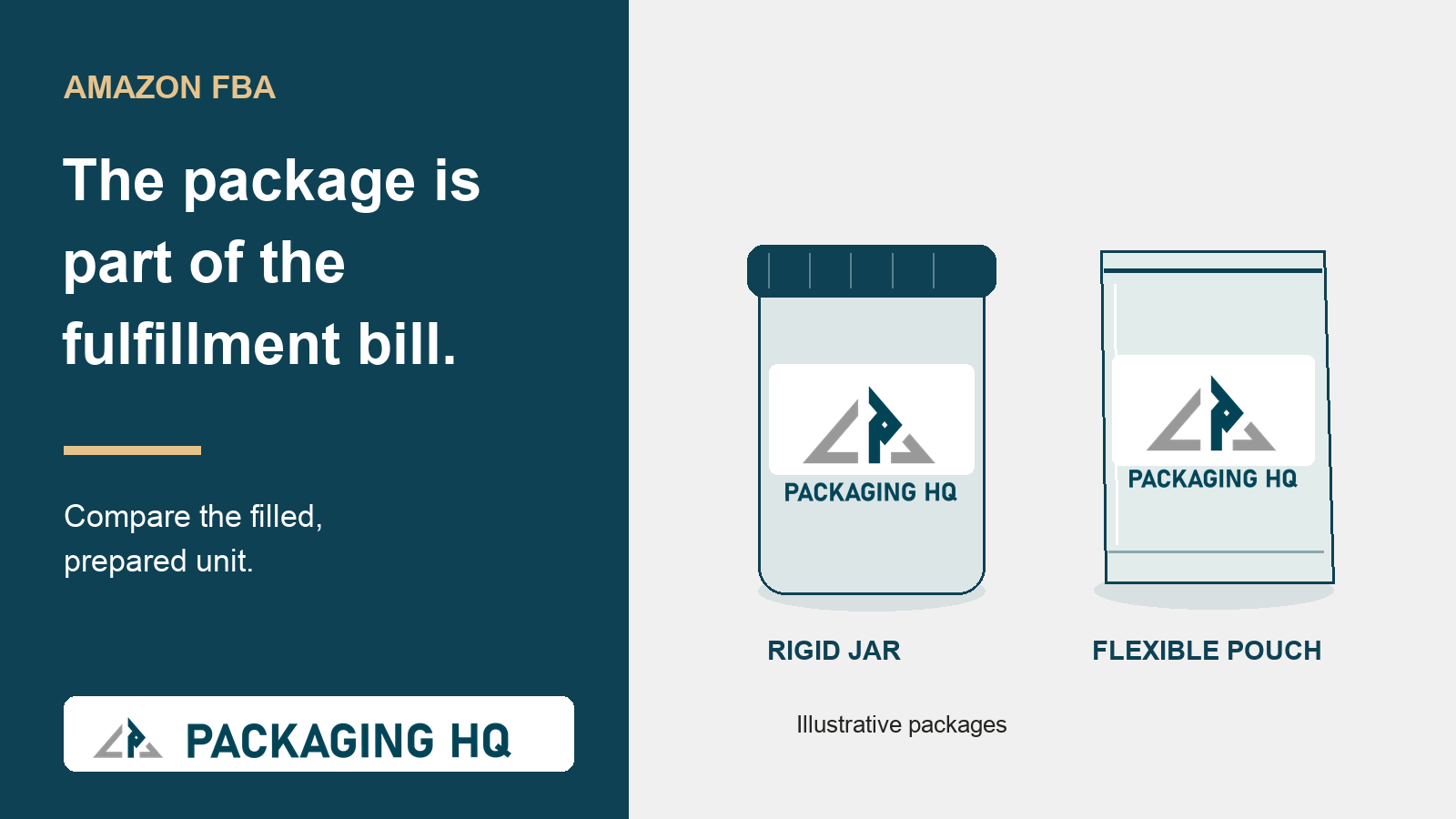
If you sell through Fulfillment by Amazon (FBA), the package around your product is part of the fulfillment bill. Amazon measures the packaged unit, assigns a size tier and a billable weight, then applies a fee based on the product's price and other attributes. Changing a rigid bottle to a pouch can lower that fee when the finished unit crosses a billing boundary. A lighter package that stays in the same band may save nothing on fulfillment. 1 2
Packaging HQ can help a brand compare its current filled package with a proposed format, gather supplier and filling inputs, and plan a measured trial. That starts with the actual Amazon fee record and production-ready package, not an empty pouch sample. If you have an active Amazon packaging cost question, schedule a conversation with Packaging HQ.
01
Amazon bills the prepared unit
For the current U.S. FBA program, Amazon's small standard tier has a maximum thickness of 0.75 inch and a maximum weight of 16 ounces. A filled pouch can easily exceed that thickness and remain large standard, even if the film itself is thin. Large standard units can be up to 18 by 14 by 8 inches and 20 pounds under the 2026 tier definitions. The size tier and fulfillment charge depend on the fully packaged sellable unit Amazon records. 1 2
For large standard units, Amazon compares scale weight with dimensional weight and generally bills using the larger one. Dimensional weight is length times width times height, in inches, divided by 139. That is why unused air in a rigid container, a bulging pouch, a protective overbag, or a carton can matter. Amazon may verify measurements itself and use its recorded dimensions when calculating fees. Measure the filled, sealed, labeled unit with all required preparation, across more than one production sample. 1 2
02
An illustrative case: about $0.98 less in the current peak period
Consider one hypothetical dry, nonapparel, nondangerous product priced between $10 and $50, sold as a single U.S. FBA unit. Assume both versions qualify for ordinary FBA, neither receives a Ships in Product Packaging (SIPP) adjustment, and Amazon records these exact finished measurements:
| Prepared unit | Filled dimensions | Scale weight | Dimensional weight | Billable band | 2026 peak base FBA fee |
|---|---|---|---|---|---|
| Rigid jar | 8 x 6 x 6 in. | 1.50 lb | 288 / 139 = 2.07 lb | Large standard, over 2 to 2.25 lb | $6.29 |
| Flexible pouch | 9 x 6 x 2.5 in. | 1.20 lb | 135 / 139 = 0.97 lb | Large standard, over 1 to 1.25 lb | $5.34 |
Amazon's published peak FBA table runs from October 15, 2026 through January 14, 2027. It lists the two base fees above for this price and product category. The base difference is $0.95. Applying the current 3.5% fuel and logistics surcharge to both fees makes the modeled difference approximately $0.98 per fulfilled unit. This is a fee comparison, not a measured customer result or a promise of $0.98 in profit. Amazon charges FBA fulfillment per unit, so a multi-unit customer order is not the same thing as one billed unit. Rates change by date, price band, category, and package measurements. 1
The example is intentionally conditional. The 8 x 6 x 6 inch jar is a bulky starting package, and the 9 x 6 x 2.5 inch filled pouch must be physically achievable for the product. If production pouches bulge past the proposed dimensions, if protection requires a carton, or if the product falls into another fee category, the calculation changes. Use the seller's Fee and Economics Preview or Revenue Calculator to check the current ASIN and proposed configuration before presenting any savings to a finance team. 1 2
03
The fulfillment fee is only one line
The package decision also changes the cost of materials, printing, filling, sealing, labels, preparation, inbound freight, placement, storage, damaged goods, and returns. Amazon's storage charge uses the space occupied by inventory, so a smaller unit can help there, but the amount depends on actual inventory levels and time in storage. Inbound placement charges depend on the shipping plan. A lower fulfillment fee can be offset by a more expensive pouch, a slower filling line, or additional protective preparation. 3 4
Start with a current SKU and compare two complete landed-and-fulfilled cost builds. Record the ASIN, current fee and Amazon dimensions, actual unit weight, package specification, production cost, fill quote, units per case, inbound plan, and expected storage exposure. Then request a filled prototype of the candidate package and repeat the measurements. A pouch dimension on a drawing is not a billing result.
Use the FBA package cost comparison worksheet to keep the fee example and unverified costs separate.
The product still has to reach the customer in good condition. For dry foods, supplements, pet treats, or liquids, the right barrier, seals, closure, and handling performance may differ substantially. Test leakage, shelf life, damage, and the co-manufacturer's running conditions as relevant to the product. A conversion that saves a fee but increases product loss is a poor conversion.
04
Do not count a SIPP discount without eligibility
Amazon's SIPP program concerns products that can ship in their own certified product packaging. It is separate from ordinary FBA acceptance. A pouch is not automatically SIPP eligible, and Amazon's Flexible SIPP guidance excludes human food, liquids, and certain loose granular products. Do not add a SIPP benefit to a bottle-to-pouch model until the exact product and package have been accepted and the seller can see the adjustment in its fee records. 5
There is another current operational detail: Amazon ended its U.S. FBA prep and item-labeling services for shipments created on or after January 1, 2026. Build any required preparation into the supplier, co-manufacturer, or third-party logistics quote rather than reusing an old Amazon prep-fee estimate. 6
05
Which products deserve a closer look?
The strongest candidates are SKUs with a current charge near a weight or size boundary, enough volume to make the difference meaningful, and a product that can safely move to a smaller finished package. A rigid package with generous headspace may be worth testing. So may a pouch that is currently overpacked or placed in an avoidable outer carton. Other products will show no fulfillment-fee change at all. A bottle can still be the better package when the product, filling line, shopper experience, or total cost calls for it.
Packaging HQ can work with your team to compare the current package and a proposed pouch or other format, sharpen supplier questions, organize the evidence, and plan a controlled trial. Bring the ASIN, current Amazon fee record, a filled sample, and your volume estimate to a Packaging HQ call. We can identify whether a fee boundary is plausible and what needs to be proved before a change earns its place on the line.
FREQUENTLY ASKED QUESTIONS
FAQs
Does Amazon give a discount just because a product is in a pouch?+
No general pouch discount appears in the ordinary FBA fee table. Size tier, billable weight, price band, product category, and any separately verified program adjustment determine the fee. 1 2
Is the $0.98 example a customer saving?+
No. It is a labeled peak-period fulfillment-fee calculation from hypothetical dimensions and weights. Net savings require actual Amazon records and the full cost of the new package, filling, preparation, distribution, and losses. 1
Will every bottle-to-pouch conversion move into small standard?+
No. Small standard requires the fully packaged unit to be no thicker than 0.75 inch and no heavier than 16 ounces. Both units in the example remain large standard. 2
Can a food or liquid pouch earn a Flexible SIPP benefit?+
Amazon's Flexible SIPP guidance excludes human food and liquids. Ordinary FBA eligibility is a separate question; evaluate its economics without assuming SIPP credit. 5
What should a brand send for an initial review?+
Send the ASIN, current fee preview, Amazon's recorded dimensions and weight, filled samples, package specification, selling price, monthly unit volume, and available filling and freight costs. That is enough to identify missing inputs and decide whether a controlled package trial is justified.
Primary sources
1. Amazon Seller Central, 2026 U.S. FBA fulfillment fee changes.↗Current nonapparel peak rate table, price bands, dates, surcharge, fee examples, and seller fee-preview tools. Seller sign-in may be required to render the page.
2. Amazon Seller Central, product size tiers.↗2026 tier dimensions, billable weight rules, and Amazon measurements. Seller sign-in may be required.
3. Amazon Seller Central, monthly inventory storage fees.↗Storage volume and rate framework. Seller sign-in may be required.
4. Amazon Seller Central, FBA inbound placement service fee.↗Placement options and fees depend on the shipping plan. Seller sign-in may be required.
5. Amazon Seller Central, Flexible SIPP guidelines.↗Program scope and exclusions. Seller sign-in may be required.
6. Amazon Seller Central, FBA prep service.↗U.S. prep and item-labeling service changes. Seller sign-in may be required.