

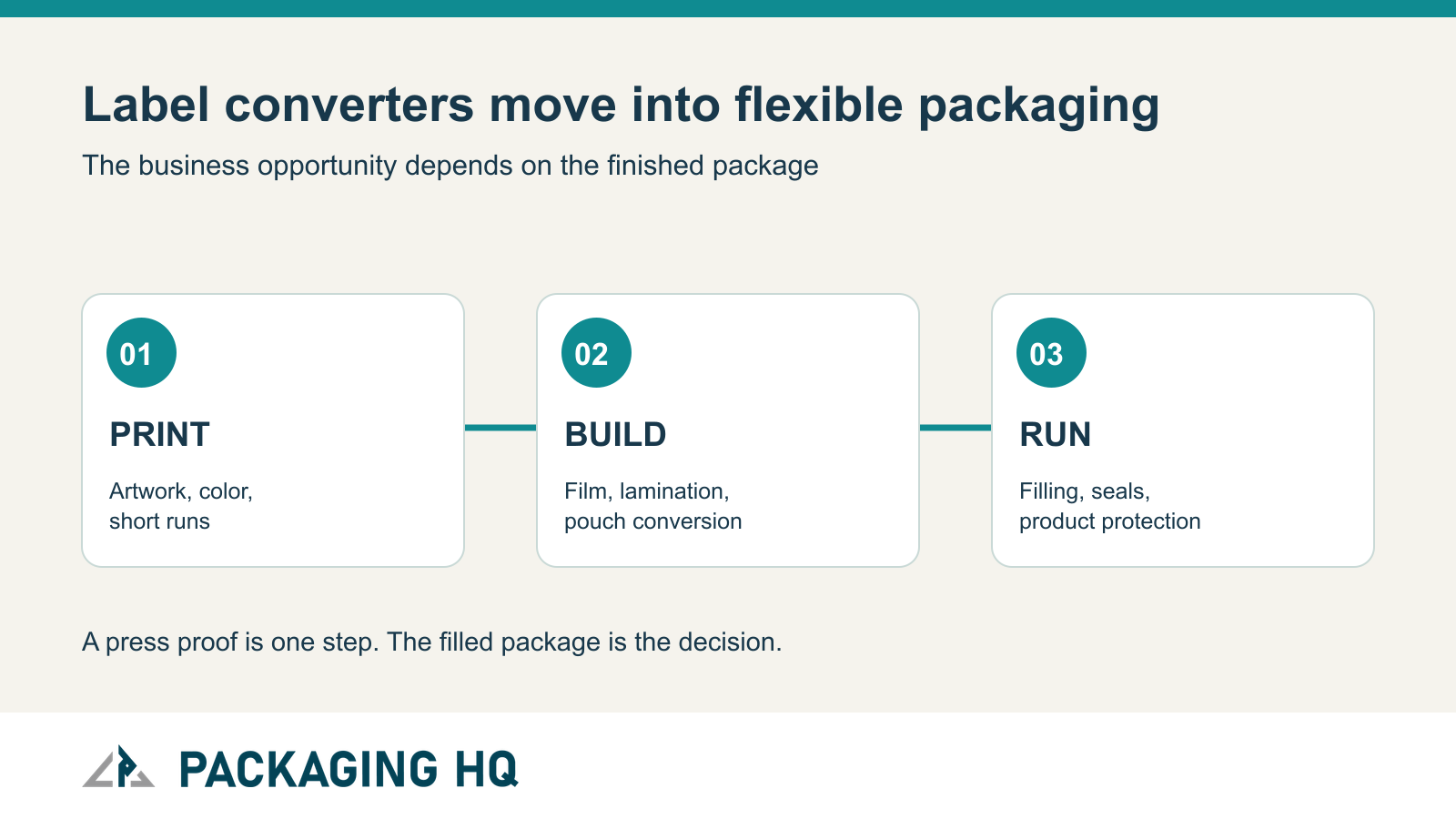
A brand that buys labels from a responsive printer may ask the same company for its next stand-up pouch. The offer can make sense: one team already knows the artwork, brand colors, launch calendar, and small-SKU headaches. But a well-printed roll of film is not yet a qualified package. Before moving a snack pouch or supplement sachet to a new supplier, compare the full construction, converting steps, and filling-line results with the package you use now. Packaging HQ can help organize those supplier inputs, identify avoidable cost, and plan that comparison. Start a packaging review with your current specification and a filled sample.
The shift is visible in the market. At LOUPE Americas, held September 15-17, 2026, the organizer described narrower and mid-width equipment moving into flexible packaging. Its post-show report identified an ABG pouch-making demonstration, a Mark Andy press configured for flexible materials, and an HP Indigo flexible-packaging job followed by lamination. 1 These are evidence of supplier investment and show-floor capability, not proof that every label printer can make every pouch. Labels & Labeling, in a preview by LOUPE's strategic director, framed the opportunity around short runs, multiple versions, customization, and faster response. 2
01
Why the business case is attractive
Many label converters already serve the people who decide how a product looks on shelf. They are used to frequent artwork changes, small batches, seasonal versions, color approvals, and rapid reorders. Those habits fit a growing brand with ten pouch flavors, a promotion, or a launch that may change after the first production run. A supplier that can coordinate print, lamination, finishing, and pouch making may shorten the number of handoffs a buyer manages. That is a possible service advantage, not a guaranteed saving. 2
For the converter, flexible packaging can add work from an existing customer rather than require a new relationship from scratch. The formats within reach may include printed rollstock, shrink sleeves, sachets, three-side-seal bags, and stand-up pouches. Equipment offerings show how the production chain is expanding: ABG markets Galaxy pouch-making lines, while Mark Andy has promoted a press for converters balancing label volume with flexible packaging and shrink-sleeve demand. 3 4 These supplier descriptions establish what is offered. They do not establish the economics or suitability of a specific customer's job.
The buyer's benefit is flexibility, particularly when demand is uncertain. Ordering smaller releases across several SKUs can reduce obsolete printed inventory if artwork or forecasts change. But minimums, material waste, lamination, pouch conversion, freight, and the cost of another production change still belong in the quote. A shorter print run is not automatically a cheaper finished pouch. Ask for the delivered, usable package cost and the reorder plan, not just a price per printed impression.
02
The new responsibility starts after the image prints
A pressure-sensitive label is normally applied to another container. A flexible pouch is the container. Its film layers must protect the product, its seals must survive handling, and its dimensions must fit the filling process. Printing is one part of a chain that can include film selection, surface treatment, inks, adhesive lamination, cure, slitting, pouch forming, closures, and inspection. LOUPE's preview described that wider equipment and material ecosystem alongside printing. 2 The practical question is who owns the finished-package specification when those steps occur at different plants.
For a pet-treat bag, the buyer may need a certain moisture barrier, puncture resistance, zipper function, and shelf appearance. For a supplement sachet, the fill weight, seal area, tear opening, and product sensitivity may be different. The label supplier may have excellent press capability while relying on a specialist for film, lamination, or pouch making. That arrangement can work, provided the brand knows who approves each handoff, who retains test records, and who answers when a filled pouch fails.
Adhesive cure and ink choice also deserve more attention than they do on a decorative label. The U.S. FDA explains that the compliance basis for a food-contact article depends on its components and intended use, including adhesives and coatings. 5 A buyer should request documentation for the actual finished structure and food-use conditions, then have the qualified regulatory team review it. A generic statement that a printer makes food labels does not answer whether its new pouch construction is suitable for a particular food.
03
A successful press proof is not a filling trial
Film can print beautifully and still cause trouble downstream. Ask the converter and co-packer for the target roll width, winding direction, splice rules, slip or coefficient of friction, pouch dimensions, and seal window. Coefficient of friction is simply how easily film surfaces slide over equipment and each other. Amcor describes controlling it as one way to improve machinability. 7 Too much or too little slip for a line can affect feeding and handling. Sealing depends on the material and equipment settings; the correct range has to be checked on the actual job.
Amcor's packaging-trial discussion illustrates why a production-like run matters: its teams fill, seal, and test proposed materials before a wider rollout, and they evaluate runnability, seal performance, and efficiency. That is Amcor's described process, not a promise about another supplier. 6 For your job, agree in advance on a representative run, acceptable seal results, reject categories, and who inspects retained filled packs. If a converter outsources pouch making, include the outside plant and the filler in that plan.
04
How to compare a new supplier fairly
Begin with the current package, not with a machine brochure. Give each candidate the same product, expected shelf life, format, dimensions, artwork versions, annual volume range, order pattern, and filling-line details. Request a layer map, barrier and seal targets, food-contact documentation when relevant, a conversion route, and a proposed line trial. Ask who owns corrections after the first trial and whether the quote includes all finishing and changeover steps.
Do not let a proposed mono-material or recycle-ready film become an unsupported claim about the finished pouch. Closures, inks, adhesives, barriers, collection access, and actual recycling remain separate questions. A new converter may offer a useful design, but the full package and relevant recovery system need their own review.
This move into flexible packaging is real and commercially interesting. The strongest supplier is the one that can connect the short-run service a brand wants with evidence that the finished package works. Use the label-to-flexible-packaging buyer checklist to compare candidates on the same requirements. If you are considering a new source, talk with Packaging HQ about the current package, the proposed change, and the trial you need before committing inventory.
FREQUENTLY ASKED QUESTIONS
FAQs
Can my label printer make stand-up pouches?+
Some can print and convert flexible material, and some offer pouch making directly or through partners. ABG's pouch-line offering shows the equipment is available. Ask the supplier which steps it performs, who owns the final specification, and what finished-pouch testing it will provide. 3
Does a short print run mean a lower pouch cost?+
Not necessarily. The cost depends on the complete job: film, print setup, lamination, slitting, pouch making, waste, freight, reorder frequency, and potential obsolete inventory. Compare delivered usable packages and the ordering plan, not print speed alone. 2
Does food-label experience establish food-pouch compliance?+
No. FDA's component review is tied to the intended food-contact use of the material. Request documentation for the exact pouch construction and have the qualified regulatory team assess it. 5
What should we test before moving a pouch job?+
Compare the current and proposed constructions, then run a representative filling trial with defined checks for feeding, seals, rejects, and filled-pack performance. Amcor's described trial process illustrates why production conditions matter. 6
Primary sources and attributed industry reporting
1. LOUPE Americas, 2026 post-show report, September 28, 2026.↗Event organizer account of equipment demonstrations and market focus.
2. Labels & Labeling, Flexible packaging at LOUPE Americas 2026, August 4, 2026.↗Trade coverage written by LOUPE Global's strategic director; its business interpretation is attributed in the article.
3. AB Graphic International, Pouch Making Machines.↗Manufacturer description of Galaxy pouch-line offering.
4. Mark Andy, LOUPE Americas 2026 equipment page.↗Manufacturer description of label, shrink-sleeve, and flexible-packaging press applications.
5. U.S. Food and Drug Administration, Determining the Regulatory Status of Components of a Food Contact Material.↗Official guidance on component-specific intended-use review.
6. Amcor, Speed Up Packaging Approval, April 28, 2026.↗Manufacturer account of production-like material trials; cited as its own practice.
7. Amcor, AmPlify finishing technologies, July 22, 2020.↗Manufacturer explanation linking coefficient-of-friction control with machinability.