

If your brand sells a snack pouch or a single-serve sachet, switching its outer material to paper sounds straightforward. The actual decision is harder: Will the new package protect the product for its full shelf life, seal on the filling line, and reach a real recovery system where customers use it? A material substitution that fails one of those tests is not much of an improvement.
Packaging World’s October 2026 issue reported the launch of the PaperFlex Consortium, a joint research effort by Colgate-Palmolive, Mars, Nestlé, PepsiCo, Procter & Gamble, and Unilever. Read Packaging World’s article. Its useful point for packaging buyers is that the companies are pooling research because a reliable, scalable paper replacement for many small flexible packs does not yet exist. 1 2
If a paper structure is on your roadmap, Packaging HQ can help document the current package, compare a supplier’s proposed construction with it, organize test evidence, and plan a trial with the production team. Contact Packaging HQ to discuss the package before a material change becomes a launch commitment.
01
What the consortium is doing
The Ellen MacArthur Foundation convened PaperFlex, with (RE)SET supporting the work, in September 2026. The group intends to develop and trial paper-based alternatives to small flexible plastic packs in markets where formal collection and recycling are limited. Research areas include coatings, product protection, shelf life, usability, and performance on manufacturing lines. Each founding company will still make its own packaging decisions. This is a research program, not an announcement that a common paper pouch has passed commercial qualification. 2 3
That distinction matters. A buyer could reasonably see the six names and assume a supplier has solved the problem for every snack, supplement, or personal-care pack. The consortium itself says current solutions do not yet meet the needed combination of performance, scale, and cost. The right response is to ask what a candidate structure has proved for a specific product and market. 2 3
02
Start with the job your current pack performs
Paper is a substrate, not a complete functional specification. A coffee sachet, powdered supplement stick pack, and oily snack wrapper ask different things of the package. Before comparing materials, record the current pack’s structure, dimensions, product-contact surface, target shelf life, seal geometry, filling conditions, and known failure modes. If the current pack already has a complaint or line problem, define that separately so it does not get hidden inside a sustainability project.
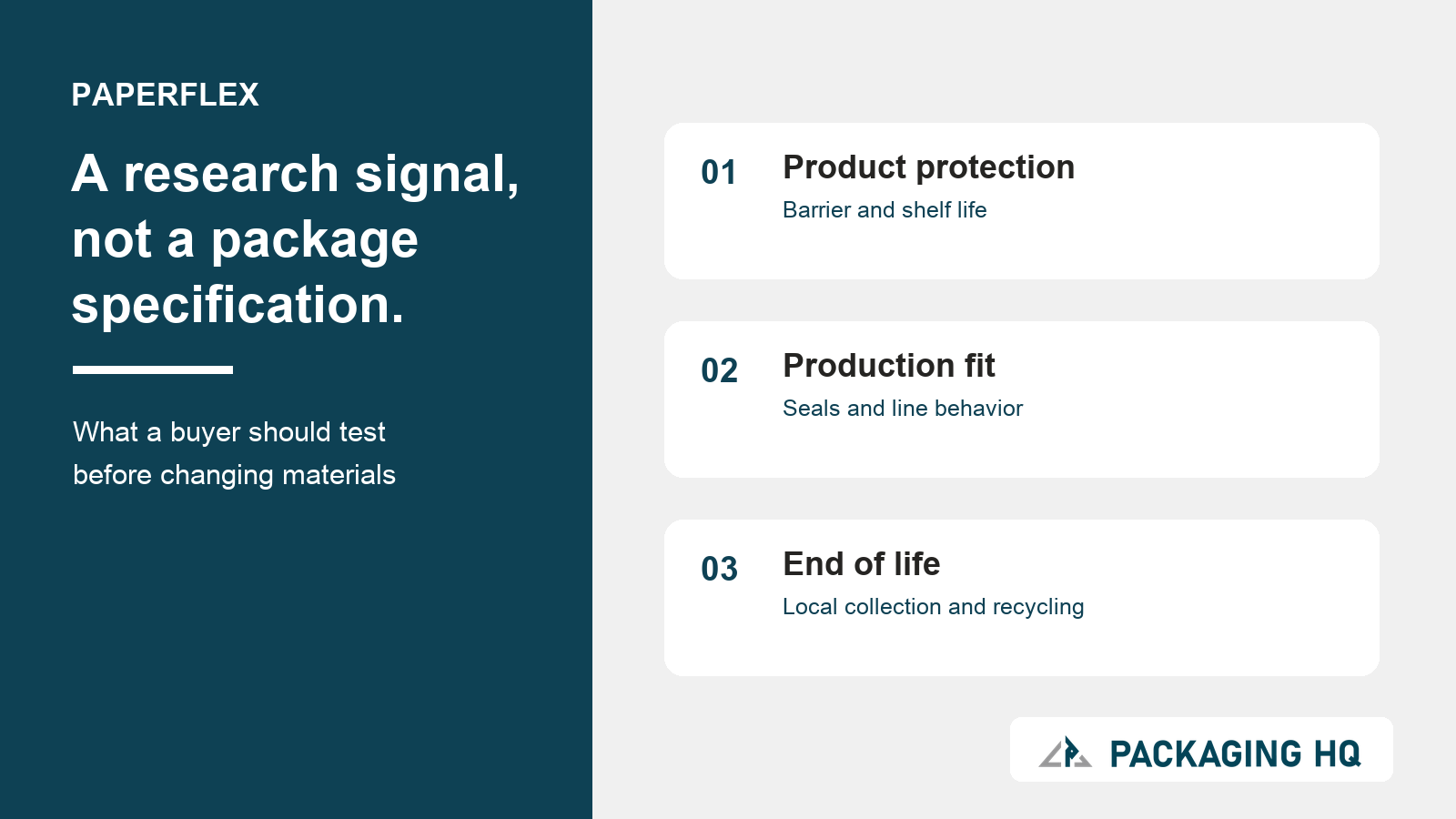
Then ask the proposed paper supplier for the complete construction, including coatings, adhesives, inks, and the material that actually forms the seal. Request evidence for the finished pack, rather than a data sheet for the paper alone. Depending on the product, testing may need to cover moisture or oxygen protection, grease resistance, seal strength, opening experience, drop damage, and print durability. The qualification target is the product in its real distribution conditions, not a generic claim that paper provides a barrier. PaperFlex’s own research scope includes protection, shelf life, and line performance for this reason. 2 3
On the line, the question is equally specific. Can the structure unwind, register, form, fill, and seal at the required speed without excess scrap? What happens when powder or oil reaches the seal area? Can the same pack run on the co-manufacturer’s equipment, or does the change require tooling, heat-setting changes, or a slower target? These are questions for a controlled trial with the people who operate the equipment. A sample that looks good in a meeting is only the start.
03
Keep recycling and biodegradation claims separate
PaperFlex has a dual ambition: alternatives that can be recycled as local collection systems improve and that are biodegradable if they accidentally reach the environment. Those are different claims and require different evidence. The Foundation’s March report says a responsible alternative must be locally recyclable, responsibly sourced and produced, technically and economically workable, safe, and compatible with a wider circular economy. It also says collection and recycling infrastructure still need investment. 2 4
For a buyer, “paper-based” does not establish that a finished coated wrapper is accepted by a local paper program. A lab result may show technical recyclability, but local collection and actual recycling at scale are separate questions. Nor should a biodegradation goal be treated as permission to litter or as proof that a specific commercial pack breaks down in every environment. Ask for the test method, conditions, complete-pack construction, and markets covered by each claim. Do not move a claim onto artwork until the relevant evidence and review are complete.
The geography in PaperFlex’s announcement is important. Its emphasis is on markets with high leakage and weak collection systems. A package that is promising there may still need a different end-of-life assessment in a U.S. or European market. Likewise, a paper design that works for one small dry product may not protect a high-fat or moisture-sensitive product. The material family alone is not the decision. 2 4
04
A practical comparison before a trial
Put the current package and the paper candidate side by side. First compare product protection and the shelf-life evidence. Next compare sealing, filling speed, scrap, and handling on the intended line. Then compare delivered pack cost, including any changed run rate, yield, tooling, and product loss. Finally, record the specific collection route and evidence behind each end-of-life claim in the markets where the product sells.
The trial should have a pass or fail decision for each of those questions. If a supplier cannot yet provide barrier data or a local recycling assessment, leave the item open. A staged test is still useful: it can show exactly which technical gap remains and prevent an attractive concept from being mistaken for a qualified launch package.
The next meaningful PaperFlex update will be a named construction with repeatable product and line results, clear coating and seal details, and credible recovery evidence for a defined market. Until then, the consortium is a strong signal of demand for innovation, not a universal replacement specification. If your team is weighing a paper alternative, talk with Packaging HQ. We can help sharpen supplier questions, compare the candidate with the current pack, organize evidence, and plan the packaging trial.
FREQUENTLY ASKED QUESTIONS
FAQs
Has PaperFlex released a commercial paper pouch?+
The published announcement describes planned collaborative research and trials. It does not identify one universal, fully qualified pack for all products. 2 3
Is a paper-based pouch automatically recyclable?+
No. The finished construction, its coatings and seal layer, local acceptance, and actual collection route all matter. The Foundation makes local recyclability one of its design criteria. 4
Does “biodegradable” mean the package can be discarded outdoors?+
No. PaperFlex describes biodegradability as a fallback for accidental environmental leakage, not a disposal instruction. A specific claim needs evidence for the exact finished pack and stated conditions. 2
What should a brand test first?+
Start with the product’s protection and shelf-life needs, then check sealing and filling on the intended line. Assess end-of-life claims for the actual sales markets before approving artwork or a changeover.
Primary sources and cited reporting
1. Packaging World, “Six CPG Giants Join Forces on Paper-Based Flexible Packaging,” September 16, 2026.↗Trade reporting in the October 2026 issue that prompted this analysis.
2. Ellen MacArthur Foundation, PaperFlex launch announcement, September 16, 2026.↗3. Ellen MacArthur Foundation, “Tackling small-format flexible packaging: the PaperFlex Consortium,” September 16, 2026.↗4. Ellen MacArthur Foundation, “Paper as one part of the solution to flexible packaging pollution,” March 9, 2026.↗