

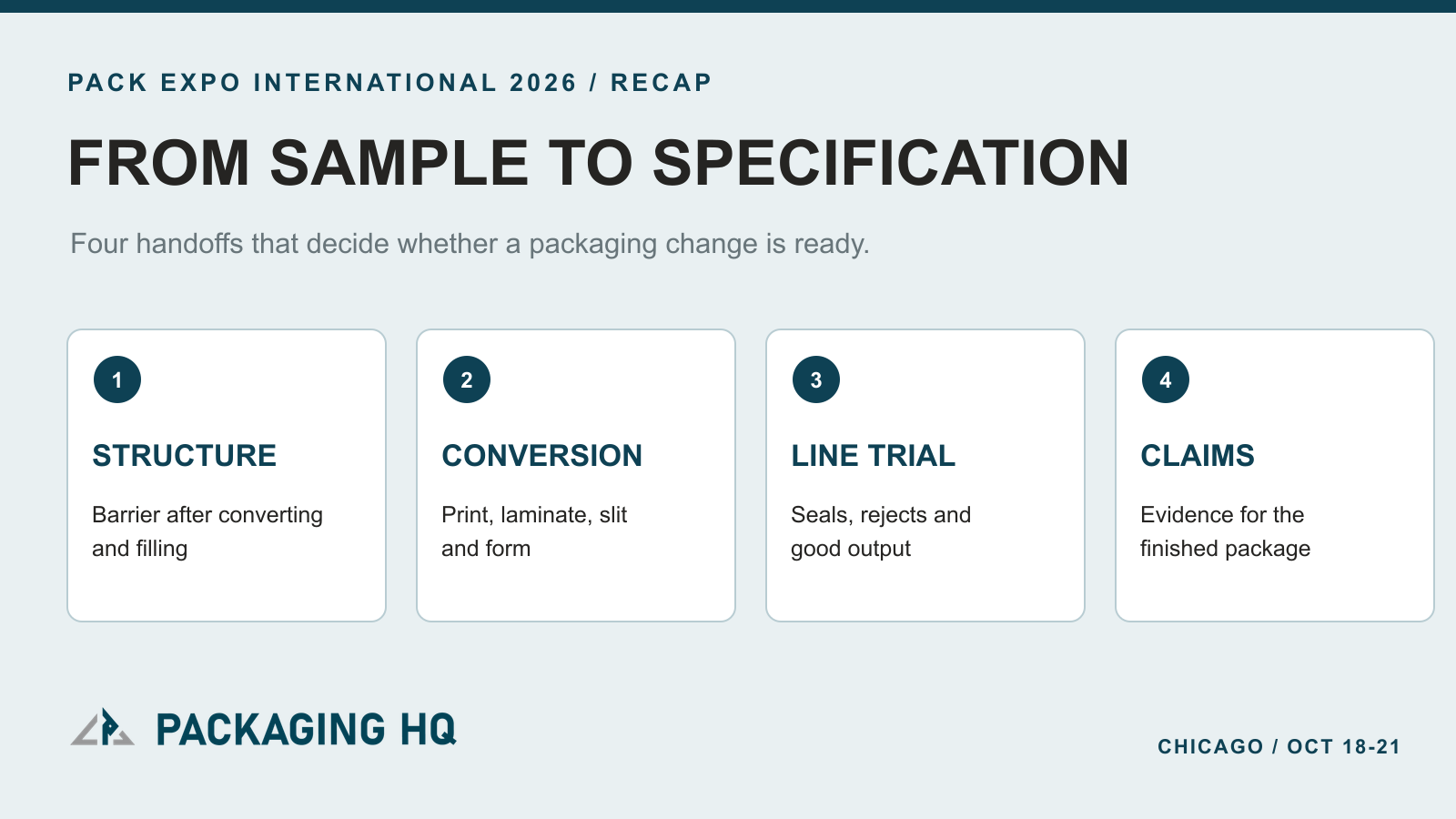
PACK EXPO International ran in Chicago October 18 to 21. For a brand deciding what pouch to buy next, the useful result is a list of changes worth testing against its current package. PMMI says the four-day show brought together more than 2,700 exhibitors. That does not prove any individual technology is ready for your line. 1
If you have an active redesign, launch, cost question, or line problem, schedule a conversation with Packaging HQ. Bring the current structure, a filled sample, and the proposed change. We can help organize supplier evidence, compare options, and plan a trial. This analysis is based on the cited organizer, supplier, and show-floor reporting, not Packaging HQ attendance.
01
Barrier ideas need a finished-package answer
On October 20, show attendees voted Mitsui Chemicals America's TAKELAC WPB 341 water-based barrier coating the Technology Excellence Award winner in the food and beverage category. PMMI describes oxygen and moisture barrier applications in mono-material and paper-based structures, including transparent retort pouches. An attendee-voted award identifies a development worth examining. It does not establish shelf life, retort suitability, or recycling outcomes for a buyer's finished pouch. 2
Mitsui's technical material describes coating combinations on paper and film, with specific drying and sealing conditions. A coating has to work with the print web, adhesive or primer, sealant, and converting process. Ask for oxygen and water-vapor transmission results on the finished structure, at conditions relevant to your product. Ask what happened after flexing and pouch making. For retort, request data after the heat process. Compare shelf life and cost against the current laminate. 3
Packaging World's October 19 booth video showed Mamata presenting RecTech, a nine-layer coextruded film with an EVOH barrier positioned as an alternative to PET/PE laminates. That is an exhibitor's proposed route, not independent verification of every barrier, price, or recycling claim made in the video. A PE-family structure can still contain a functional barrier layer, inks, and other components. The right question is whether the complete printed and sealed package fits the applicable design-for-recycling criteria and an actual collection route. “Mono-material,” “designed for recycling,” accepted by a program, and actually recycled at scale are not synonyms. 4
02
Printing and conversion can change the economics
A short-run printing pitch makes sense for many flavors or seasonal versions. The hard part is calculating the whole job: artwork approval, ink compatibility, lamination, slitting, pouch making, scrap, minimum orders, and obsolete inventory. Packaging World editors reported on show-floor coding technology and code quality at production speed. A clean code on one substrate does not qualify the same code on your film after sealing and distribution. 5
Amcor's show page announced an in-booth Moda Bag system that forms bags from shrink tubing and prints changing graphics in-line. The proposed benefit is less preprinted inventory, not a proven saving for every user. Request an all-in comparison: usable output, legibility, material and labor cost, changeover waste, and inventory at risk. 6
03
A good film still has to seal on your line
An October 18 show-floor video of Harpak-ULMA's medical flow wrapper showed monitoring seal pressure and checking for product in the seal or folded film. It is a medical-packaging example, not a promise for snack or pet-food lines. The principle travels: inspect the failure modes your product and film can create. The video provides no independently measured defect reduction. 7
Independent reporter Lindy Hughson also described a Heat and Control/Ishida small-bag demonstration with an in-line seal checker. Its published demo speed is not a rate for your product and film. Ask for a trial using your product and film, with agreed measures for seal integrity, leaks, rejects, good packs per hour, and startup scrap. Record the old settings and the new settings. A supplier's fast demo is a screening event; your own stable run is the buying evidence. 8
04
Inspection and AI should explain a decision
Hughson reported a Maneva booth explanation of an AI vision platform intended to move beyond pass/fail inspection and identify why a seal failed, such as product in the seal area. That is potentially valuable only if the cause label is accurate enough to change operator action. Ask to see a confusion matrix or an equivalent review of true defects, misses, and false rejects on images from your line. Establish who confirms a new defect type, how the model is retrained, and how an operator overrides it. The booth account does not establish measured waste or downtime savings at another plant. 8
For buyers, the line-level implication is practical. A new film can alter glare, print contrast, product presentation, or seal appearance. Those changes may affect an existing camera or leak check even when the material passes a lab test. Put inspection into the material trial, not into a later troubleshooting budget.
05
Treat end-of-life as a package-system question
Fresh-Lock showed a paper-pouch zipper concept with Mondi's FunctionalBarrier Paper. Hughson reported that the complete pouch was still undergoing recyclability testing at Western Michigan University. That is a useful distinction: the paper content of the web does not decide what happens to the zipper, seal areas, inks, and barrier treatment in a collection and recycling system. The same caution applies to PE or PET pouch demonstrations. In Packaging World's October 20 booth video, HPM Global described a mono-PET pouch and linked it to PET bottle recycling rates. Bottle collection figures cannot establish collection of flexible PET pouches. Ask for an assessment of the exact finished pack in the intended market before putting a recycling instruction on it. 8 9
End-of-life is only one part of the decision. A design that uses less material but increases leaks or product waste may miss the business goal. Compare protection, line output, total delivered cost, and claim evidence. Request the exact scope of any supplier certificate or recognition.
06
Leave the show with a trial brief
The strongest follow-up is a one-page comparison. State the current package and problem: oxygen pickup in coffee, zipper failure, seal contamination, startup waste, or obsolete inventory. Ask for full construction, test methods and conditions, finished-pack claim basis, and samples for a controlled run. Decide what improvement means before testing.
Use the Packaging HQ post-show evidence plan to track requests and a trial decision, without treating vendor claims as proven results.
Packaging HQ offers mono-material retort pouches and mono-material spouted pouches for various applications. Neither suits every product or process, and “mono-material” does not prove recyclability. To test or trial a material, contact us with your product, filling conditions, current pack, and target. We can compare supplier evidence and plan a line trial.
Service should fit the buying program too. Depending on volume and supply, we can explore just-in-time delivery, inventory programs, or fast lead-time options. We would compare delivered cost and stock exposure with your current setup. The aim is to support growth and improve margin where the economics justify it. Schedule a call for a redesign, launch, cost question, or line problem.
FREQUENTLY ASKED QUESTIONS
FAQs
Did an award-winning barrier coating prove my pouch is recyclable?+
No. PMMI's award was an attendee vote for a technology. Ask for data and a recycling assessment covering the complete printed, sealed package in the market where it will be sold. 2
Is a mono-material pouch the same as a single-layer film?+
No. The Mamata demonstration described a nine-layer coextruded film with an EVOH barrier. “Mono-material” describes a design approach, not necessarily one physical layer or automatic acceptance in collection. Request the layer composition and the exact claim basis. 4
Can I use a show-floor machine speed in my cost model?+
Not without a comparable trial. Product, film, bag size, settings, inspection limits, and startup conditions change usable output. The Heat and Control/Ishida figure in show-floor reporting is a demonstration description, not a validated rate for your SKU. 8
What should I ask an AI inspection supplier?+
Ask for misses, false rejects, cause-label accuracy, operator review, and results on images from your actual line. The reported Maneva booth explanation is a product description, not independent evidence of savings. 8
SOURCES
PMMI, PACK EXPO International 2026 opening release, October 18. Organizer primary source for event dates, location, and exhibitor count.↗PMMI, 2026 Technology Excellence Award winners, October 20. Organizer primary source for winner, attendee voting, and its description of TAKELAC.↗Mitsui Chemicals Europe, TAKELAC barrier solution technical sheet. Supplier primary source for related coating applications; the illustrated grade and construction are not a specification for the award entry or any Packaging HQ product.↗Packaging World, Mamata RecTech show-floor video, October 19. Exhibitor remarks recorded at the show; claims are attributed to Mamata.↗Packaging World editors, Through the Line podcast from PACK EXPO, October 20. Independent trade coverage of show-floor coding and materials.↗Amcor, PACK EXPO 2026 exhibitor page. Supplier primary source for described in-booth Moda Bag printing demonstration; not independently measured savings.↗Packaging World, Harpak-ULMA show-floor flow-wrapper video, October 18. Exhibitor demonstration recorded at show.↗PKN Packaging News, Lindy Hughson, Pack Expo show-floor highlights, October 22. Independent first-person reporting on Fresh-Lock, Maneva, and Heat and Control/Ishida. Figures and capabilities described by exhibitors remain supplier claims.↗Packaging World, HPM Global mono-PET pouch show-floor video, October 20. Exhibitor remarks recorded at show; PET bottle rates do not substantiate flexible-pouch collection.↗